Garage Geniuses and Glue Guns: How Backyard Tinkerers Are Building the Future of Owl Conservation One Box at a Time
Somewhere in suburban Ohio, a retired electrical engineer named Dale is soldering a microphone array onto a weatherproof housing unit at 11 p.m. on a Tuesday. His wife has long since gone to bed. The dog has given up waiting for attention. Dale doesn't notice. He's trying to isolate the acoustic signature of a fish owl call from the ambient noise of a drainage creek behind his property, and he won't stop until he gets it right.
This is what owl conservation looks like in 2025. Not just field researchers in waders and universities with grant funding — but also Dale. And hundreds of people just like him, scattered across the country, quietly out-engineering each other in the name of keeping owls fed, safe, and breeding.
Welcome to the most productive arms race you've never heard of.
From Plywood to Platform: A Brief History of the Owl Box
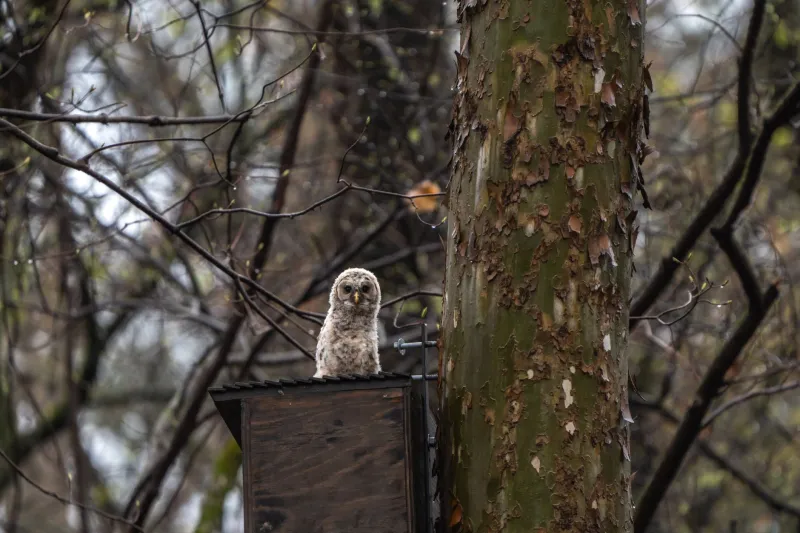
The original owl box was, bless its heart, not complicated. A few planks of untreated wood, a hole of the right diameter, a drainage slot in the floor, and a mounting bracket — done. These humble structures genuinely helped populations of cavity-nesting owls that had been squeezed out by development, and for a long time, that was enough.
Then the internet happened.
Once backyard birders could share designs, swap data, and one-up each other on forums and Facebook groups, the owl box stopped being a passive shelter and started becoming a habitat system. People began asking harder questions. What's the internal temperature during a heat wave? Is the entrance hole positioned to minimize predator access? Are the nesting materials right for the region? Does the mounting height account for local flood patterns?
These aren't trivial concerns. They're the difference between a box that sits empty for three seasons and one that successfully fledges owlets year after year. And it turns out, a lot of the people asking these questions have backgrounds in engineering, construction, and technology — which means they also have the tools to answer them.
The Sensor Revolution Nobody Talked About
The most significant leap in backyard owl habitat tech over the last decade hasn't been structural — it's been informational. Cameras, yes, but also temperature and humidity loggers, weight sensors embedded in floors to detect occupancy, and increasingly, acoustic monitoring systems that can identify species by call and log activity patterns over months.
In California, a semi-retired software developer named Priya built a mesh network of acoustic sensors along a half-mile stretch of riparian habitat near her property. The system uploads data nightly and flags unusual activity — a second owl in the territory, a call pattern suggesting a distressed chick, extended silence that might indicate nest abandonment. She can check it from her phone while sitting in a dentist's waiting room.
"I'm not a scientist," she's quick to point out. "But I can write code and I care about what's happening out there. So I made a tool that lets me pay attention at a scale I couldn't manage on my own."
Her dataset, now spanning four years, has been voluntarily shared with two university research programs who had no equivalent long-term acoustic record for that habitat corridor. Her garage project became someone else's peer-reviewed data.
Why "Better Than Your Neighbor's" Is Actually Great for Owls
Here's the thing about competitive instincts in conservation communities: when the competition is about who can build the most functional, most data-rich, most owl-friendly habitat system, everybody wins. Including the owls.
When one person in a neighborhood installs a well-designed owl box, it helps. When six people within a half-mile radius do it — each one iterating on the last design, sharing what worked and what didn't, plugging data gaps the others missed — you've created something closer to a managed habitat network. Prey populations get regulated. Territory overlap gets documented. Juvenile dispersal patterns become visible in ways they simply aren't when you're working from isolated anecdotes.
In the Pacific Northwest, a loose collective of about forty homeowners along a river corridor has been doing exactly this for the past five years. They call themselves, with zero irony, the Riparian Irregulars. Their combined monitoring network has documented nesting success rates, tracked individual birds across multiple seasons using acoustic ID signatures, and identified two previously unknown territory boundaries that are now informing a county-level habitat management plan.
None of them have biology degrees. Several of them met because they kept showing up at the same creek at odd hours with binoculars and thermal scopes.
The DIY Tech Stack: What's Actually Inside These Boxes Now
For anyone curious what the cutting edge of backyard owl habitat engineering actually looks like right now, here's a rough sketch:
Cameras: Infrared-capable, motion-triggered units with night vision that can stream live or upload clips to cloud storage. Some enthusiasts are running dual-camera setups — one inside the box, one covering the entrance — to capture both interior behavior and arrival/departure patterns.
Environmental sensors: Small, inexpensive loggers that track temperature and humidity inside the nesting cavity. Critical for understanding whether boxes are overheating in summer or staying dry enough in wet climates.
Weight sensors: Embedded floor plates that can detect when a box is occupied, when eggs are present, and roughly how many birds are inside based on weight fluctuations. Crude, but surprisingly informative.
Acoustic monitors: The frontier right now. Open-source software like BirdNET can analyze recordings and flag calls by species, making it possible to monitor activity across a large area without being physically present. Enthusiasts are mounting microphones on fence posts, tree branches, and custom-built weather stations.
Data dashboards: Several people in this community have built their own visualization tools — simple web apps that pull sensor data and display it as charts, maps, or alerts. A few of these have quietly become the best available monitoring tools for specific habitat types in their regions.
What This Means for the Rest of Us
If you've been putting off building an owl box because the basic design felt too simple to matter, or because you saw someone else's setup and felt outclassed — stop. The community that built those sophisticated systems started exactly where you're standing.
Start with the box. Get the dimensions right for your target species, use untreated wood, mount it correctly, and put it somewhere with appropriate habitat. That's already more than most people do.
Then, if you want to go further, go further. Add a camera. Join a local monitoring group. Share your data somewhere it can be used. The Riparian Irregulars didn't start as a coordinated network — they started as a few people who liked owls and happened to live near the same creek.
Dale, by the way, eventually got his acoustic sensor working. It detected a fish owl call on its third night of operation — a species he hadn't confirmed on his property in twelve years of casual observation. He uploaded the recording, flagged it in the regional database, and then went to bed.
Sometimes the garage project changes everything. Sometimes it just confirms what you hoped was true. Either way, the owl was there. And now someone knows about it.