Built Different: How Fish Owl Eyes Make Your Fancy Camera Look Like a Disposable from Walgreens
Let's set the scene. It's 11:47 PM on a moonless Wednesday. You're crouched in a damp blind near a Pacific Northwest creek, camera bag digging into your spine, thermos of cold coffee in one hand, and a $2,200 mirrorless camera body in the other. You've got a fast f/1.4 lens attached, ISO cranked so high the preview looks like a gravel driveway, and you are still not seeing anything useful.
Meanwhile, roughly thirty feet away, a Blakiston's fish owl is standing ankle-deep in that same creek, casually spotting a trout through six inches of dark water, in conditions your camera's autofocus gave up on twenty minutes ago.
Nature: 1. Your credit card statement: 0.
The Hardware Specs Nobody Asked For (But Everybody Needs)
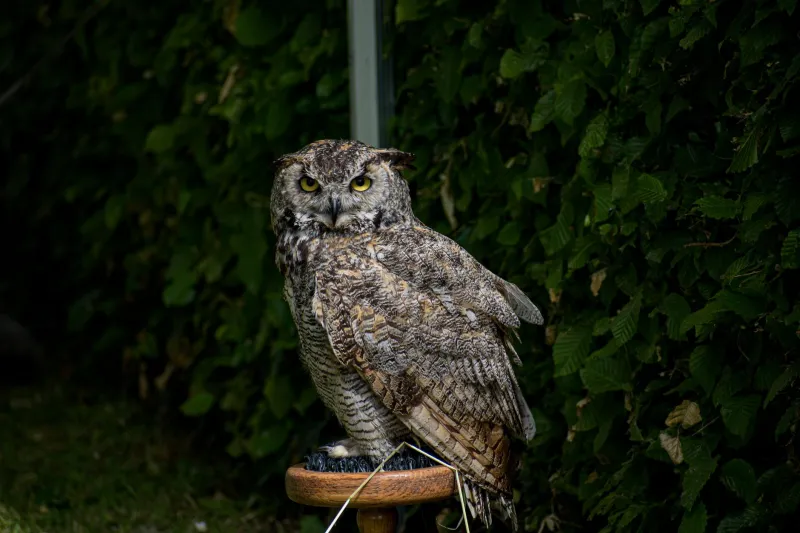
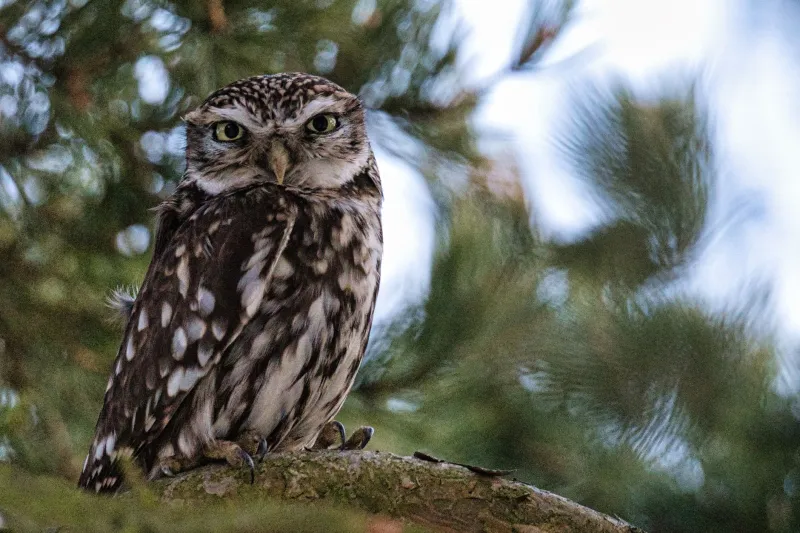
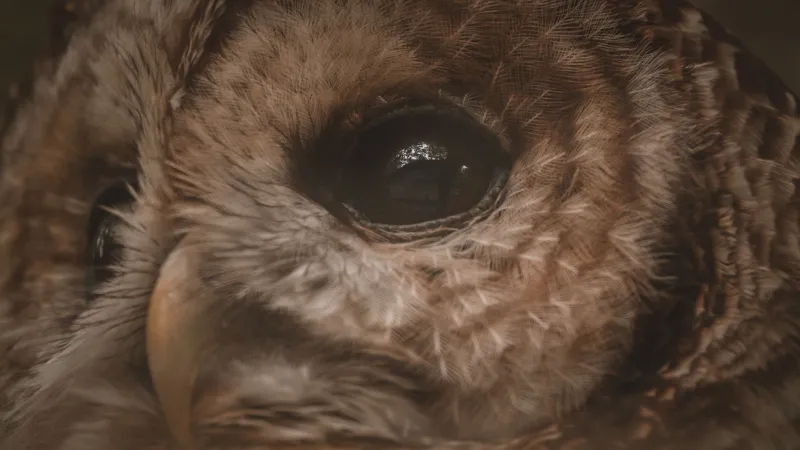
To understand why fish owl eyes are basically the Leica of the animal kingdom, you have to start with the basics. Owls have what ophthalmologists lovingly call "tubular eyes" — meaning their eyeballs aren't actually spherical like yours. They're elongated tubes packed with photoreceptors, and they're so large relative to skull size that owls literally cannot move them. That's why owls rotate their entire heads. They're not being dramatic. They just have no choice.
Dr. Patricia Holloway, a comparative ophthalmologist based in Portland who has spent more than a decade studying raptor vision, puts it bluntly: "If a human had proportionally equivalent eyes, each one would be the size of a softball. We'd look absolutely terrifying, but we'd be able to read a menu in a cave."
The rod-to-cone ratio in an owl's eye is staggering. Rods handle low-light, motion-sensitive vision. Cones handle color and detail in bright conditions. Owls have so many rods packed into their retinas that they can detect meaningful movement in light levels approaching absolute darkness — roughly 100 times dimmer than what a human eye needs to function. Your fancy camera needs a certain minimum of photons hitting the sensor before it produces anything other than digital noise. An owl's retina is pulling useful information from conditions where photons are basically rumors.
The Aperture Flex That Puts Your Fast Glass to Shame
Here's where it gets genuinely humbling for anyone who has ever bragged about owning a fast lens.
A camera lens's aperture — the opening that controls how much light enters — is measured in f-stops. A wide f/1.4 aperture is considered extremely fast, meaning it lets in a lot of light. Wildlife photographers spend serious money chasing low f-stop numbers for exactly this reason.
Owl pupils, when fully dilated in darkness, open to an aperture roughly equivalent to f/1.1 — and unlike a glass lens, they're biologically adaptive, adjusting in milliseconds to changes in ambient light. Austin-based wildlife photographer Marcus Delray, who has spent the better part of eight years photographing raptors across the American Southwest and Pacific coast, laughs when this comparison comes up.
"I have a lens that cost more than my first car," Delray says. "It's f/2.8. An owl is walking around with better glass than me, built into its face, for free, since birth. It's genuinely offensive."
Ultraviolet Vision: The Cheat Code Nobody Talks About
If the low-light performance weren't enough, fish owls — and many raptors generally — appear to have at least partial sensitivity to ultraviolet light. This is where the conversation stops being merely humbling and becomes almost philosophically unfair.
Many small mammals, including the voles and rodents that make up a significant portion of some owl diets, produce urine that fluoresces under UV light. In other words, prey animals are essentially leaving glowing trail markers through the landscape that owls may be able to perceive and humans cannot see at all — not with naked eyes, not with standard cameras, not with most commercially available optical equipment.
Dr. Holloway describes it this way: "Imagine if your food left a lit path directly to itself. That's potentially what some raptors are working with. It's like the prey world has a neon sign that only predators can read."
For fish owls specifically, hunting at the water's edge in near-total darkness, the combination of extreme light sensitivity and potential UV perception creates a sensory picture of the environment that human technology can approximate only in fragments — thermal imaging here, image intensification there — but never in the integrated, real-time, always-on package that sits behind those enormous amber eyes.
The Depth Perception Problem (That Owls Solved and We're Still Working On)
Hunting a moving fish through a reflective water surface at night isn't just a light-gathering problem. It's a geometry problem. Water refracts light, meaning objects beneath the surface appear to be in a different position than they actually are. Strike at where the fish looks like it is, and you miss. Strike at where it actually is, and you eat.
Fish owls have forward-facing eyes that provide significant binocular overlap — the same design principle that gives humans strong depth perception. But their brains process the resulting stereoscopic information with a speed and precision that allows split-second compensation for water refraction during a hunting strike. Delray watched a Blakiston's fish owl make a successful strike on a moving fish in a shallow run one October night in Washington state and describes the moment with a mix of awe and mild existential crisis.
"It was over in maybe two seconds. Dark, reflective water, moving target, the owl just — did it. I had my camera on a tripod with a tracker, and I still barely got the shot. It wasn't even trying that hard. It looked bored."
So Why Do We Even Bother?
The honest answer is that we bother because we are stubborn, optimistic creatures who find deep meaning in the attempt. There's something genuinely worthwhile about a person dragging $3,000 worth of camera equipment into a cold marsh at midnight to try to document something that a bird does effortlessly with anatomy it was born with. It's absurd, and it's also kind of beautiful.
But the next time you're chimping through blurry, noisy frames from your latest night shoot, muttering about needing a faster lens or a better sensor, consider the fish owl. It has no gear bag. It has no memory cards. It has no firmware updates pending. It has two eyes, four million years of iterative design, and an unbroken record of finding fish in the dark.
Your camera is impressive. Fish owl eyes are a masterpiece.
And somewhere out there tonight, one of them is absolutely destroying the competition — on a creek bank, in the dark, without even breaking a sweat.