Your Ears Are Lying to You: The Jaw-Dropping Sound World Fish Owls Actually Live In
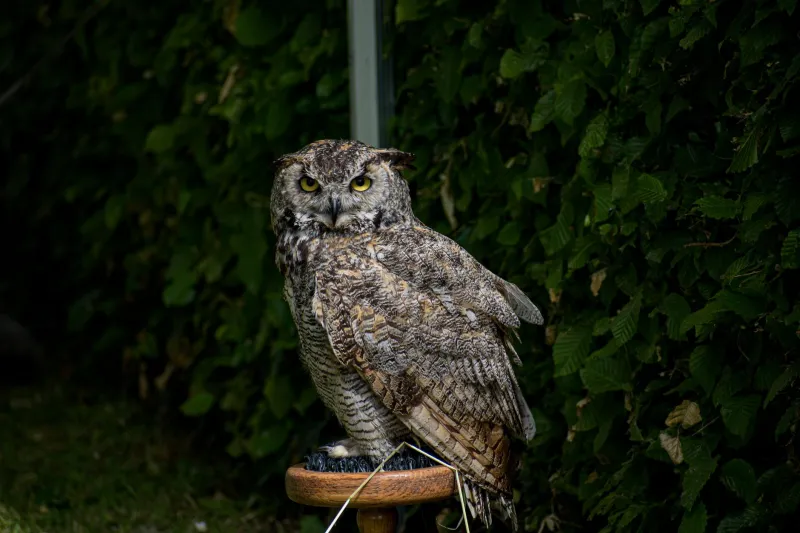
You were there. You had the moment. A fish owl perched at the water's edge, moonlight doing its cinematic best, and you hit record on your phone like the wildlife documentarian you absolutely are in your heart. You watched the footage back. You heard: wind, a distant car, maybe your own breathing, and a vague splashy thud when the bird struck the surface.
The owl heard an entirely different universe.
This is the story of that universe — and why the gap between what fish owls perceive and what we can even begin to capture is one of the most humbling reminders that nature was not, in fact, designed with our smartphones in mind.
The Architecture of an Ear That Actually Works
Human hearing is fine. Perfectly adequate for ordering at a drive-through, catching song lyrics, and detecting when someone across the office is eating chips too loudly. But it is, by the standards of nocturnal raptors, embarrassingly basic.
Owls have evolved what biologists sometimes call asymmetrical ear placement — one ear positioned slightly higher on the skull than the other. This isn't a design flaw. It's a precision instrument. The offset allows owls to triangulate sound in three dimensions, pinpointing the exact location of a noise source not just left-to-right, but up-and-down simultaneously. For fish owls hunting in near-total darkness over rippling water, this is the difference between dinner and going to bed hungry.
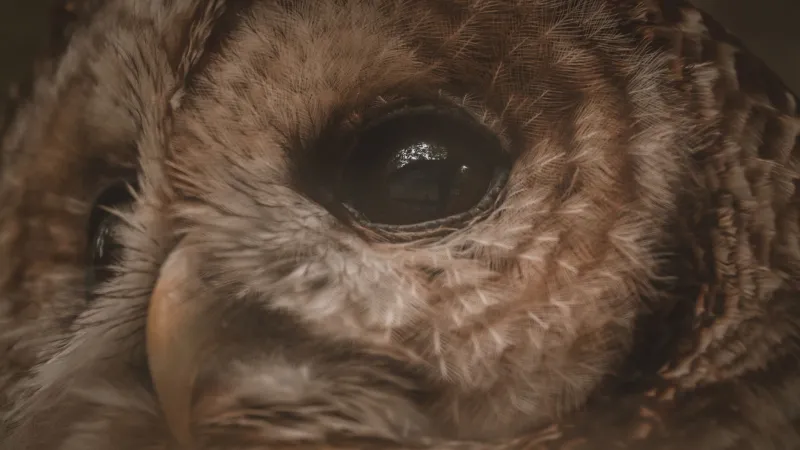
The facial disc — that distinctive, slightly unsettling flat face that makes owls look perpetually surprised — functions as a living satellite dish. Those feathers aren't just decorable. They channel sound waves toward the ear canals with remarkable efficiency, amplifying incoming audio in ways that no smartphone microphone, and frankly very few professional recording setups, can replicate from the outside.
Some owl species can detect sounds as quiet as 0 decibels — the threshold of human hearing — under conditions where we'd hear absolutely nothing. Fish owls, hunting over water where surface noise creates constant acoustic interference, have developed sensitivity tuned specifically to the frequencies made by fish moving just below the surface. They're not hearing everything. They're hearing exactly the right things.
Why Your Video Sounds Like a Broken Washing Machine
Here's what your phone's microphone is doing while you're filming: it's capturing everything with cheerful indifference. Wind turbulence across the mic housing. The low rumble of highway traffic two miles away. The high-frequency hiss of leaves. Your camera app's built-in noise reduction is simultaneously trying to "help" by flattening out the very frequencies that would be most interesting.
Professional wildlife sound recordists spend thousands of dollars on directional microphones, parabolic reflectors, and windshields that look like they belong on a Dr. Seuss creature, specifically because capturing clean, directional audio in outdoor environments is genuinely difficult. And even then, they're recording what we can hear — the 20 Hz to 20,000 Hz range that represents the outer limits of human auditory perception.
Fish owls are operating on frequencies and at sensitivity levels that our entire recording ecosystem wasn't designed to document. The subtle acoustic signature of a fish breaking the surface tension of water at 2 a.m. in a dark creek? That's not showing up on your reel.
The Water Problem Nobody Talks About
Water makes everything harder. It reflects sound. It generates its own broadband noise — the constant low-frequency roar of moving water, the irregular plinks and gurgles of a stream doing its thing. For human ears, and for most recording equipment, this creates a wall of background noise that drowns out fine detail.
Fish owls have evolved to hear through this. Research on related species suggests their hearing is particularly sensitive in the frequency ranges that cut through water-surface interference — essentially, they've got a built-in filter for the exact acoustic environment they hunt in. It's like having noise-canceling headphones that were custom-tuned for a single, specific situation, and that situation is catching fish in the dark.
Your phone has noise canceling too. It's trying to make your calls sound cleaner. It is not optimized for riparian raptor acoustics. These are different goals.
What You Can Do (That Actually Helps)
None of this means you should put the camera away. It means you should use it differently, and supplement it with something more important: your own intentional attention.
Ditch the screen for five minutes. Seriously. Before you start recording, stand still with your phone in your pocket and just listen. Let your auditory system adjust to the ambient noise. You won't hear what the owl hears, but you'll hear more than you would if you'd spent that time squinting at a screen.
Record longer than you think you need to. The interesting audio moments in wildlife encounters are almost never the ones you anticipate. Let the recording run while you're not actively watching — sometimes the ambient soundscape around an owl's hunting territory tells a richer story than the hunt itself.
Consider a directional mic attachment. Several companies make shotgun microphone attachments for smartphones that run under $100. They won't make you a BBC sound engineer, but they'll dramatically improve your ability to capture directional audio and reduce the omnidirectional noise soup that built-in mics collect.
Note what you can't hear. This sounds strange, but keeping a field journal that includes acoustic observations — "heard nothing before the strike," "complete silence for 40 seconds before bird moved" — builds a more complete picture of owl behavior than video alone. Absence of sound is data.
Look up bioacoustics projects. Organizations like the Cornell Lab of Ornithology run citizen science programs that use acoustic monitoring to track bird activity. Contributing recordings, even imperfect ones, to these databases has genuine scientific value. Your mediocre creek audio might be someone's data point.
The Humility Is the Point
There's something genuinely wonderful about the realization that fish owls are experiencing a sensory world we can barely gesture at. In an era when it feels like every wild moment needs to be captured, optimized, and posted, the owl's acoustic universe is a useful reminder that documentation and understanding are not the same thing.
You can have the video and still have missed the experience. You can have no video at all and have been fully, completely present for something extraordinary.
The owl doesn't care about your frame rate. It's busy hearing things you'll never hear, hunting in a sonic landscape your best equipment can only approximate, operating with sensory tools that took millions of years to develop and that no app update is going to replicate.
That's not a reason to put the phone away forever. It's a reason to hold it a little more loosely — and to spend at least part of every wildlife encounter just listening, badly, with your perfectly adequate human ears, to the edge of a world you can almost reach.