Hoot Fluency: The Surprisingly Useful Art of Understanding What Fish Owls Are Actually Saying

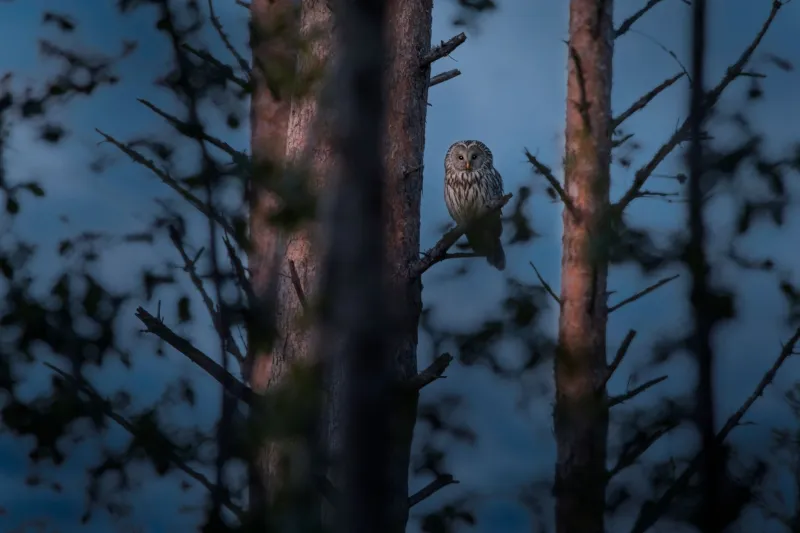
Photo by Photo by Oleg on Unsplash on Unsplash
It starts innocently enough. You're standing at the edge of a marshy creek somewhere in the American Southeast at dusk, phone in hand, running a sound-identification app because your birding group dared you to find a fish owl by ear alone. Then it happens. A noise erupts from the cattails — somewhere between a foghorn, a disgruntled sea lion, and a man who has just stubbed his toe in the dark. You freeze. Your app spins. And somewhere in the reeds, a large, fish-scented owl judges you silently.
Welcome to the world of fish owl acoustics, where the learning curve is steep, the hours are ungodly, and the payoff — for both you and the wetlands you're monitoring — is genuinely remarkable.
A Vocabulary Built on Intimidation and Negotiation
Fish owls are not subtle communicators. Unlike the classic, cinematic "hoo-hoo" of a great horned owl (which, let's be honest, was always a little too polished), fish owls lean into a more chaotic sonic palette. Researchers in bioacoustics describe their calls as falling into several loose categories: territorial booms, pair-bonding duets, alarm calls, and what one University of Florida field researcher cheerfully labeled "general complaint vocalizations."
The territorial boom is the flagship. Low-frequency, resonant, and designed to travel across open water, it's the owl equivalent of posting a very large, very aggressive yard sign. Males typically initiate, females respond, and together they create a duet that sounds — to the untrained ear — like two people arguing through a wall in a language you almost recognize.
"The duet structure is actually what makes fish owls so useful for monitoring," explains Dr. Marguerite Hollenbeck, a bioacoustics researcher who has spent the better part of a decade recording owl vocalizations along river corridors in the Gulf Coast region. "When you hear a coordinated pair call, you're not just detecting one bird — you're confirming an established breeding territory. That's a gold mine of data with a single audio clip."
Then there are the alarm calls, which are shorter, sharper, and delivered with a urgency that strongly implies the owl has seen something it does not appreciate. Predator? Rival? A kayaker who got too close? The alarm call does not discriminate. It simply announces that something has gone wrong and that everyone in a quarter-mile radius should probably know about it.
The Rise of the Accidental Owl Linguist
Here's where things get genuinely interesting — and a little obsessive. Thanks to the explosion of free and low-cost sound recording apps like Merlin Bird ID, iNaturalist's audio features, and dedicated bioacoustics tools like Kaleidoscope Lite, a growing army of amateur naturalists across the country has started building personal libraries of fish owl calls from their local waterways. Some of them have become, by any reasonable measure, extremely weird about it.
Take Dennis Voorhees, a retired high school science teacher from coastal Georgia who started recording owl calls near a tidal creek behind his neighborhood three years ago. He now has over 400 annotated recordings, a color-coded spreadsheet tracking call frequency by moon phase, and a Slack channel with 23 members who debate the emotional subtext of specific vocalizations at hours no healthy adult should be awake.
"I can tell the difference between the male at Site A and the male at Site B just by the cadence of their opening notes," Dennis says, with the calm confidence of a man who has fully accepted what his retirement has become. "Site B guy is more aggressive. Probably younger. He starts his territorial call about forty minutes earlier in the evening than Site A, which I think means he's either more anxious or more motivated. We've had some real debates about that one."
Dennis's data, chaotic as its collection process sounds, has been submitted to two university monitoring programs and contributed to a regional population survey. His Slack channel members have collectively logged more than 1,200 verified fish owl call events in a single year. Citizen science has always run on exactly this kind of motivated, slightly unhinged enthusiasm.
What the Calls Actually Tell Us About Wetland Health
Here's the part where all of this stops being just a fun hobby and starts being genuinely important. Fish owls are what ecologists call indicator species — their presence (or absence) reflects the condition of the broader ecosystem around them. A thriving fish owl population means you've got healthy water, functioning fish populations, and enough riparian cover to support a large, demanding apex predator. A silent wetland, where the owls have stopped calling or calling less frequently, is often a wetland in trouble.
Monitoring call frequency, territory size, and duet success rates over time gives researchers a remarkably detailed picture of ecosystem stability without requiring invasive methods or enormous budgets. "Passive acoustic monitoring is one of the most cost-effective conservation tools we have right now," says Dr. Hollenbeck. "And the beauty of fish owls is that they're loud, they're consistent, and they call at predictable times. They're almost cooperating with us."
When call data from citizen scientists is aggregated and cross-referenced with water quality reports, land use changes, and fish population surveys, patterns emerge. Territories that go silent often correspond with upstream agricultural runoff events. Pairs that stop dueting may be responding to disturbance in nesting zones. The owl, in its noisy, grumpy, nocturnal way, is essentially narrating the health of its watershed in real time. You just have to learn to listen.
Getting Started Without Losing Your Mind (Completely)
If you'd like to join the growing community of people who stand in the dark near water making notes about owl sounds, the barrier to entry is refreshingly low. Merlin Bird ID, developed by the Cornell Lab of Ornithology, is free, genuinely excellent, and can identify bird calls in real time using your phone's microphone. iNaturalist allows you to submit audio observations that contribute to verified scientific databases. For the more committed, a basic parabolic microphone setup — available for under $100 — dramatically improves recording quality in the field.
The most important tool, though, is time. Fish owls are most vocal in the hour after sunset and again just before dawn, with peak activity varying by season. Spring is prime territory-establishment season, which means more calling, more dueting, and more opportunities to catch a full vocal exchange. Show up consistently to the same location over weeks and months, and you'll start to recognize individual birds the way Dennis does — not as anonymous wildlife, but as specific, recurring characters with habits and quirks and apparent opinions about their neighbors.
Will you become slightly obsessed? Almost certainly. Will you lose some sleep? Without question. Will you start to feel a strange, genuine affection for a large, fish-breathed bird you've never actually seen clearly in the dark? Statistically speaking, yes.
But you'll also be contributing real data to real conservation efforts, and you'll understand your local wetland in a way that no amount of daytime hiking ever quite delivers. That's not nothing. That's actually quite a lot.
The owls, for their part, will keep calling whether you're listening or not. The question is whether you're fluent enough yet to know what they're saying.